
Table of Contents
- Why Freshness Decides Everything When You Buy Whole Bean Coffee
- Quick Comparison: The Last Sip Single Origins at a Glance
- How to Store Whole Bean Coffee So It Stays Fresh
- The Freshness of Coffee Beans After Roast Date: What the Numbers Say
- How to Buy Freshly Roasted Coffee Beans Online Without Getting Burned
- Brewing Method Compatibility: Match the Bean to Your Setup
- Single Origin or Blend? Roast Level and Flavor Profile Basics
- Pricing, Bulk, and What You Actually Pay For
- Frequently Asked Questions
Last Updated: September 24, 2026
Why Freshness Decides Everything When You Buy Whole Bean Coffee
When you buy whole bean coffee, you're buying a perishable product that starts losing quality the moment it leaves the roaster. This guide from The Last Sip Coffee Roasters covers roast dates, storage, brewing compatibility, and how to spend well.
Roasted to Order vs. Sitting on a Shelf
Coffee roasted to order is packaged within days and shipped straight to you. Shelf coffee may have been roasted weeks or months earlier, then warehoused under fluorescent lights.
Quick Comparison: The Last Sip Single Origins at a Glance
Every coffee in The Last Sip lineup is a single origin, priced at $19.99, and roasted to order. The difference is flavor.
| Coffee | Tasting Notes | Best Brewing Method | Roast |
|---|---|---|---|
| Brazil Santos | Cocoa, smooth, full-bodied | Drip, French press | Medium |
| Colombia | Dried orange, berry, chocolate | Drip, pour-over | Medium |
| Costa Rica | Sweet apple, raisin, honey | Pour-over, drip | Medium |
| Guatemala | Dark chocolate, bright fruit, butterscotch | Drip, pour-over, French press | Medium |
| Mexico | Chocolate, cinnamon, green apple | Drip, French press | Medium |
| Nicaragua | Cocoa, floral, citrus | Pour-over, drip | Medium |
| Papua New Guinea | Caramel, honey, fruit | Drip, French press | Medium |
| Tanzania | Pear, floral, jasmine, strawberry | Pour-over, French press, espresso | Medium-light |
| Sumatra | Dark chocolate, dried fruit, earthy | French press, espresso | Medium |
| Kenya | Bright acidity, orange, lemon, floral | Pour-over, drip | Medium |
How to Store Whole Bean Coffee So It Stays Fresh
Store whole bean coffee in an opaque, airtight container at room temperature, away from light and heat. Most storage advice stops there and never explains the chemistry behind it.

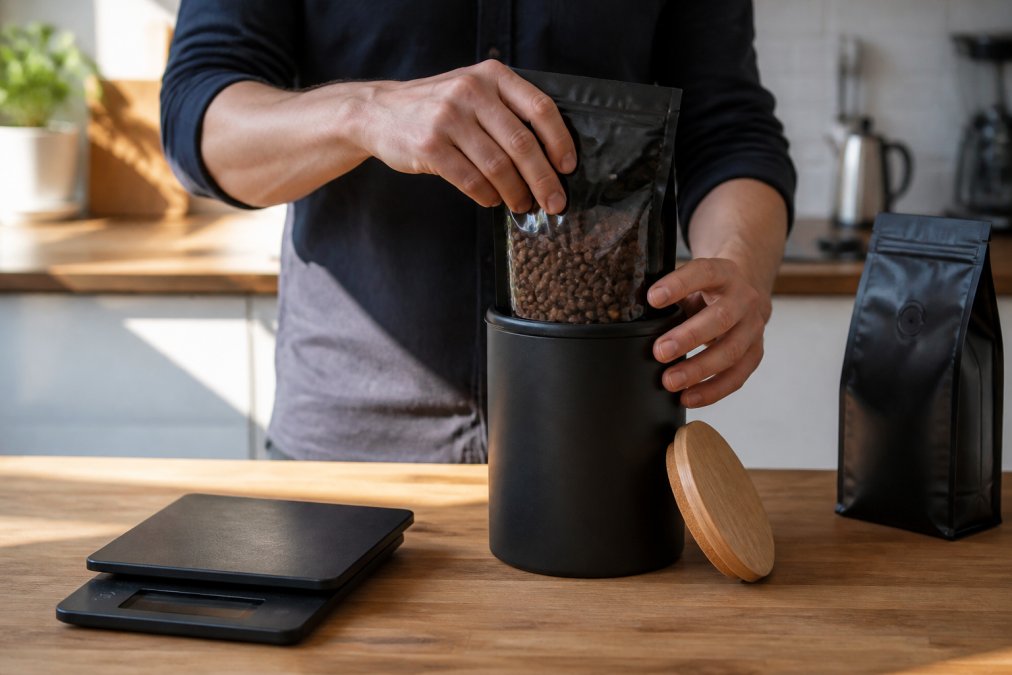
The Four Enemies: Air, Light, Heat, and Moisture
Oxygen is the biggest threat: roasted coffee's oils and aromatic compounds oxidize on contact with air, turning a bright, sweet bean flat and papery. Light and heat accelerate that reaction, and moisture invites mold and throws off extraction.
Why Degassing Changes Your Storage Timeline
Freshly roasted beans release carbon dioxide for days, the bloom you see when hot water hits fresh grounds. Sealing them airtight while they're degassing heavily traps CO2, which builds pressure and can push aroma compounds out. That's why a one-way valve bag beats a vacuum-sealed jar for the first week or two.
Freezer, Pantry, or Hopper?
The pantry wins for coffee you'll drink within two weeks. The freezer works for longer storage, but only if you do it right.
How Long Beans Actually Stay Fresh by Storage Method
There's no single freshness number, but most roasters follow this pattern:
- Sealed bag with one-way valve, pantry: Peak flavor for roughly 2-4 weeks after the roast date, then gradual decline.
- Airtight opaque canister, pantry: Similar window, with slightly better protection once degassing has slowed.
- Clear jar or hopper: Noticeable staling within about a week because light and air work continuously.
- Freezer, portioned and unopened: Flavor can hold for several months, but only if the container stays sealed until the beans reach room temperature.
The Freshness of Coffee Beans After Roast Date: What the Numbers Say
The freshness of coffee beans after roast date follows a predictable curve: peak flavor lands between a few days and a few weeks after roasting, then quality declines gradually, then faster.
A practical timeline looks like this:
- Days 1-3 after roast: Beans are degassing heavily. Great for espresso, sometimes too gassy for pour-over.
- Days 4-14: The sweet spot. Aroma, acidity, and body are at their best.
- Days 15-30: Still good, but the brightest notes start to fade.
- Beyond 30 days: Drinkable, but you're losing the qualities you paid for.
How to Buy Freshly Roasted Coffee Beans Online Without Getting Burned
Buy freshly roasted coffee beans online by checking three things: the roast date policy, shipping speed, and the freshness guarantee. Skip any roaster that won't tell you when your coffee was roasted.
- Does the product page state a roast date or roast-to-order policy?
- Is shipping fast enough that beans arrive within a week of roasting?
- Is there a freshness guarantee if the coffee arrives stale?
- Are the beans sold as whole bean, not pre-ground?
- Does the roaster list origin, process, and altitude details?
Brewing Method Compatibility: Match the Bean to Your Setup
Brewing method compatibility comes down to grind size, contact time, and whether the method highlights acidity or body. The right bean for espresso is often wrong for drip, and vice versa.
- Drip machine: Forgiving and consistent. Brazil Santos, Colombia, and Mexico shine here.
- Pour-over: Highlights clarity and acidity. Kenya, Tanzania, and Costa Rica are ideal.
- French press: Full immersion builds body. Sumatra and Guatemala excel.
- Espresso: Needs a bean with structure. Sumatra and Tanzania both work well.
The Water-to-Coffee Ratio That Fixes Most Bad Cups
Most bad cups are a ratio problem, not a bean problem. Start with 1 gram of coffee to 15-18 grams of water, and weigh both, eyeballing scoops is where inconsistency creeps in.
Brazil Santos Coffee | Medium Roast →

Single Origin or Blend? Roast Level and Flavor Profile Basics
Single origin coffee comes from one growing region; a blend combines beans from multiple origins. Single origins show off a specific place and process, while blends aim for consistency and balance, differences that show up in the cup when you buy whole bean coffee.
What Single Origin Actually Tells You
A single origin label is only as useful as the detail behind it, "Colombia" alone is a country, not a flavor. A roaster listing region, farm, altitude, variety, and process gives you what predicts taste: higher-grown beans develop denser structure and more acidity, washed coffees taste cleaner and brighter, and natural or honey processes push toward fruit and sweetness.
Why Blends Exist and When They Beat Single Origin
Blends aren't inferior; they're engineered for consistency. A roaster balances acidity, body, and sweetness from multiple origins so the result tastes the same bag after bag, which is why most cafe espresso is a blend, since a single origin's flavor shifts from harvest to harvest.
Roast Level and What It Does to Flavor
Roast level shapes flavor because heat drives chemical reactions inside the bean: as roast progresses, sugars caramelize and acids break down, moving the bean from bright and fruity toward chocolatey and smoky.
- Light roasts keep more of the bean's natural acidity and fruit. They're less forgiving to brew because under-extraction shows up quickly.
- Medium roasts balance sweetness and body, which is why they work across drip, pour-over, and French press.
- Dark roasts push toward chocolate and smoke. The roast character starts to dominate, and origin character fades.
Arabica vs. Robusta: The Species Trade-Off
Arabica dominates specialty coffee because it has more complexity and less bitterness than robusta, which is why nearly every premium bag is arabica. Robusta carries roughly twice the caffeine and a harsher, more bitter cup, so it shows up mostly in commodity blends.
How to Choose When You're Standing at the Shelf
A simple decision path works for most buyers:
- Want to explore flavor? Buy single origin and try two regions side by side.
- Want consistency? Buy a blend built for your brewing method.
- Drink mostly drip? A medium roast single origin or blend is the safest bet.
- Drink mostly espresso? Look for a blend or a medium-dark single origin with enough body to stand up to milk.
Match the bean to how you actually brew, not to what sounds most impressive on the bag.
Pricing, Bulk, and What You Actually Pay For
Every coffee in The Last Sip catalog is $19.99, which buys a single origin, roasted-to-order bag with full origin details: grower, region, altitude, variety, and process.
Frequently Asked Questions
What is the best whole bean coffee to buy?
The best choice depends on the flavor profile you enjoy. For a smooth, balanced cup with cocoa notes, a medium roast single origin like Brazil Santos works well for drip and French press. If you prefer brighter, fruit-forward coffee, look for washed African or Central American lots. Buy from a roaster that prints a roast date on the bag and roasts to order, since freshness affects flavor more than origin alone.
How do I know if whole bean coffee is fresh?
Check the roast date on the bag, not just a best-by date. Whole bean coffee tastes best within about two to four weeks of roasting, with peak flavor in the first week or two. Fresh beans also smell distinctly sweet and aromatic when you open the bag, and they release visible gas (bloom) when hot water hits them during brewing. If the beans smell flat or dusty, they are past their prime.
Does whole bean coffee stay fresh longer than ground coffee?
Yes. Grinding exposes far more surface area to oxygen, so ground coffee loses aroma and flavor within days, while whole beans can hold quality for weeks when stored properly. That is why buying whole bean coffee and grinding right before brewing gives you a noticeably better cup. A burr grinder set to your brewing method makes the biggest difference.
Where can I buy freshly roasted coffee beans online?
Order directly from a roaster that roasts to order rather than holding inventory, so your bag ships within days of roasting. Look for a published roast date, clear origin details, and fast fulfillment. Single origin offerings like Colombia, Guatemala, or Kenya give you specific flavor profiles to choose from, and ordering a few small bags at once lets you compare before committing to a larger size.
What is a good price for whole bean coffee?
Specialty single origin whole bean coffee typically runs about $15 to $25 per 12-ounce bag, depending on origin, processing, and how recently it was roasted. The Last Sip Coffee Roasters single origins are priced at $19.99 per bag. Paying in this range usually reflects careful sourcing, small batch roasting, and roast-to-order freshness rather than mass-market shelf stock.