
Table of Contents
- Why Freshly Roasted Coffee Tastes Better
- Understanding the Coffee Degassing Process
- How Long Does Roasted Coffee Stay Fresh
- Signs of Stale Coffee Beans and How to Spot Them
- Oxidation and Its Impact on Flavor Complexity
- Brewing Method Variance and Roast Level Impact
- Storage Best Practices to Maintain Freshness
- Conclusion
Last Updated: August 18, 2026
Why Freshly Roasted Coffee Tastes Better
Freshly roasted coffee delivers complexity, brightness, and aromatic intensity that stale beans cannot match. When coffee beans are freshly roasted, they actively release carbon dioxide and volatile oils carrying flavor compounds, making coffee taste vibrant and nuanced. As beans age, oxidation breaks down these compounds, and the coffee becomes flat, bitter, or sour.
The roasting process unlocks hundreds of flavor compounds through chemical reactions. Once roasting stops, a race begins: those compounds either reach your cup while potent, or they degrade before you brew. This window of peak flavor is narrow but critical.
Understanding the Coffee Degassing Process
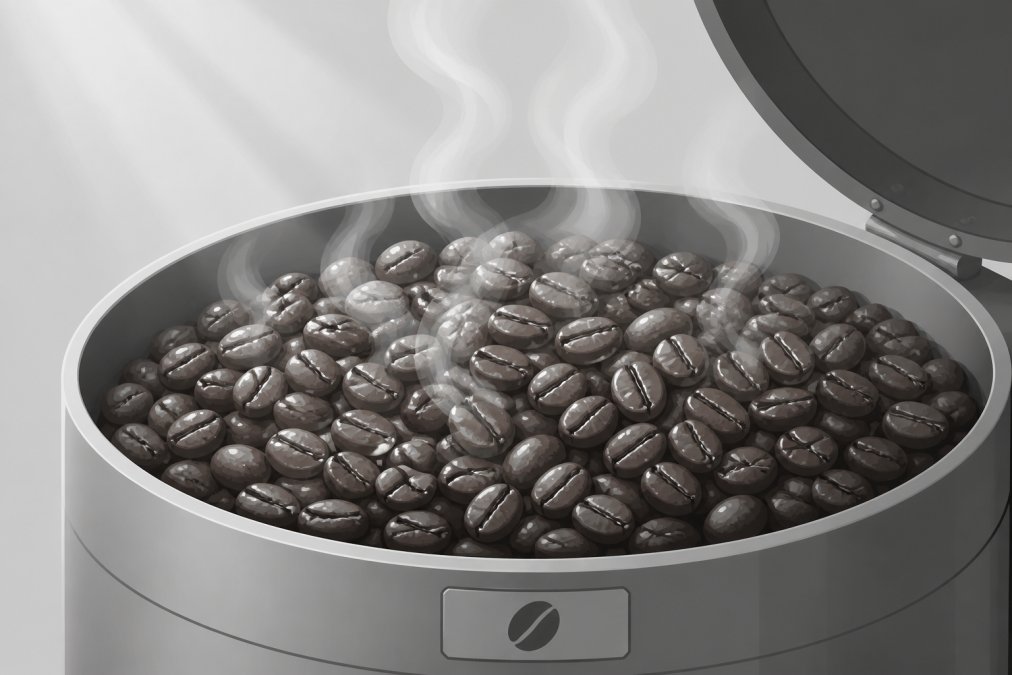
Coffee degassing is the release of carbon dioxide and other gases from roasted beans, beginning the moment roasting ends and continuing for weeks. This phase is when your coffee develops its most complex and attractive flavors.
Carbon Dioxide Release and Flavor Development
Heat during roasting produces carbon dioxide that becomes trapped inside the bean's cellular structure. After roasting stops, the bean gradually releases this gas through its surface, carrying volatile oils and aromatic compounds with it. This is why freshly roasted coffee smells so strong and tastes so vibrant.
The intensity of this process varies by roast level. Darker roasts release CO2 more aggressively in the first 24 to 48 hours after roasting, while light roasts degas more slowly but maintain complexity longer. Degassing and flavor development are interconnected: as the bean releases gas, oxygen penetrates the surface, and controlled oxidation enhances certain flavor notes during the first few days.
The Optimal Resting Period After Roasting
The ideal resting period for roasted coffee is 12 to 24 hours after roasting, though this depends on your brewing method and roast level. During this window, the bean has released enough CO2 that it won't cause excessive blooming during brewing, but hasn't yet begun losing volatile oils significantly.
For espresso, a slightly longer rest of 24 to 72 hours sometimes produces better shots because espresso's extraction method is sensitive to CO2 levels. For pour-over or immersion brewing, the 12 to 24-hour window is often ideal because you want maximum aromatic compounds reaching your cup.
How Long Does Roasted Coffee Stay Fresh
Roasted coffee maintains peak flavor for 2 to 4 weeks after roasting in ideal conditions. The shelf life depends on storage conditions, roast level, and packaging.
The Ideal Window for Peak Flavor
The peak flavor window for freshly roasted coffee is typically 5 to 30 days post-roast. From day 5 to day 14, most coffees hit their sweetest spot: aromatic compounds are fully developed, the body is balanced, and acidity is bright without being sharp. After day 14, flavors become less vibrant. By day 30, most roasted coffee has lost enough volatile oils that it tastes noticeably flatter.
Dark roasts maintain their character slightly longer than light roasts because they've already lost more volatile oils during roasting. Light roasts peak earlier but fade more quickly.
Factors That Accelerate Staling
Oxygen exposure is the most significant factor. Grinding exposes exponentially more surface area to oxygen, reducing the freshness window from weeks to days. Light and heat also accelerate staling by degrading aromatic compounds and speeding oxidation. Temperature fluctuations cause moisture to condense inside the bag, promoting mold and accelerating staling.
Humidity is another critical factor. Coffee beans are hygroscopic and absorb moisture from the air, which can cause them to become brittle and lose flavor compounds. Freshly roasted coffee stored in an airtight container in a cool, dark cupboard maintains peak flavor for about 4 weeks. The same coffee stored in a standard bag on a kitchen counter might decline noticeably within 2 to 3 weeks.
Signs of Stale Coffee Beans and How to Spot Them
The most obvious sign of stale coffee is the smell. Freshly roasted coffee has a rich, complex aroma. Stale coffee smells muted, musty, or cardboard-like. If the aroma is faint when you open the bag, the beans are past their prime.
Visually, stale beans look dull and may have a grayish tint developing on the surface. Freshly roasted beans have a glossy, vibrant appearance. In the cup, stale coffee tastes flat, sour, or overly bitter, with the complexity gone and a one-dimensional flavor.
Oxidation and Its Impact on Flavor Complexity
Oxidation is the chemical process that gradually breaks down flavor compounds in roasted coffee. Once the bean is exposed to oxygen, a slow process of degradation begins. The volatile oils carrying the most aromatic and flavorful notes are the first to break down.
The rate of oxidation depends on temperature, humidity, light exposure, and oxygen availability. A bean stored at room temperature in an airtight container oxidizes slowly, while the same bean stored in a warm, humid, light-filled environment oxidizes much faster.
The complexity of freshly roasted coffee comes from the sheer number of aromatic compounds present. As oxidation progresses, these compounds break down and disappear, leaving a simpler, flatter flavor profile. Different flavor notes degrade at different rates: the bright, fruity, floral notes characterizing light roasts often fade first, while deeper notes associated with dark roasts persist longer.
Brewing Method Variance and Roast Level Impact
The relationship between freshness requirements and brewing method is crucial for getting the best cup. Different brewing methods extract flavor differently, affecting how fresh your beans need to be.
How Brew Method Changes Freshness Requirements
Espresso is the most sensitive to bean freshness because it uses high pressure and short extraction time. Freshly roasted coffee with its full complement of volatile oils produces richer, more complex shots. Espresso requires careful attention to degassing: beans that are too fresh release CO2 aggressively, causing channeling, while beans rested 24 to 72 hours are usually ideal.
Pour-over brewing extracts more slowly and is less sensitive to degassing. A pour-over can benefit from slightly fresher beans because slower extraction time allows you to capture more aromatic compounds. French press and immersion brewing are the most forgiving regarding freshness, though they still benefit from fresher beans for more complex flavor.
Cold brew is unique because long steeping time and low temperature slow oxidation, allowing beans a month old to still taste reasonably good.
Roast Level and Its Effect on the Freshness Window
Light roasts peak early and fade faster, hitting their optimal window around 5 to 7 days post-roast and declining noticeably by day 14. Medium roasts peak around 7 to 10 days and maintain good flavor through day 21. Dark roasts have the longest freshness window, tasting good from day 3 through day 30 post-roast, though they still taste noticeably better when fresher.
This variance is why roast date matters more for light roasts than dark roasts. If you prefer light roasts, buying freshly roasted coffee is essential.
Storage Best Practices to Maintain Freshness
Proper storage is the difference between coffee that maintains peak flavor for weeks and coffee that becomes stale in days. The goal is to minimize oxygen exposure, protect against light and heat, and maintain consistent humidity.
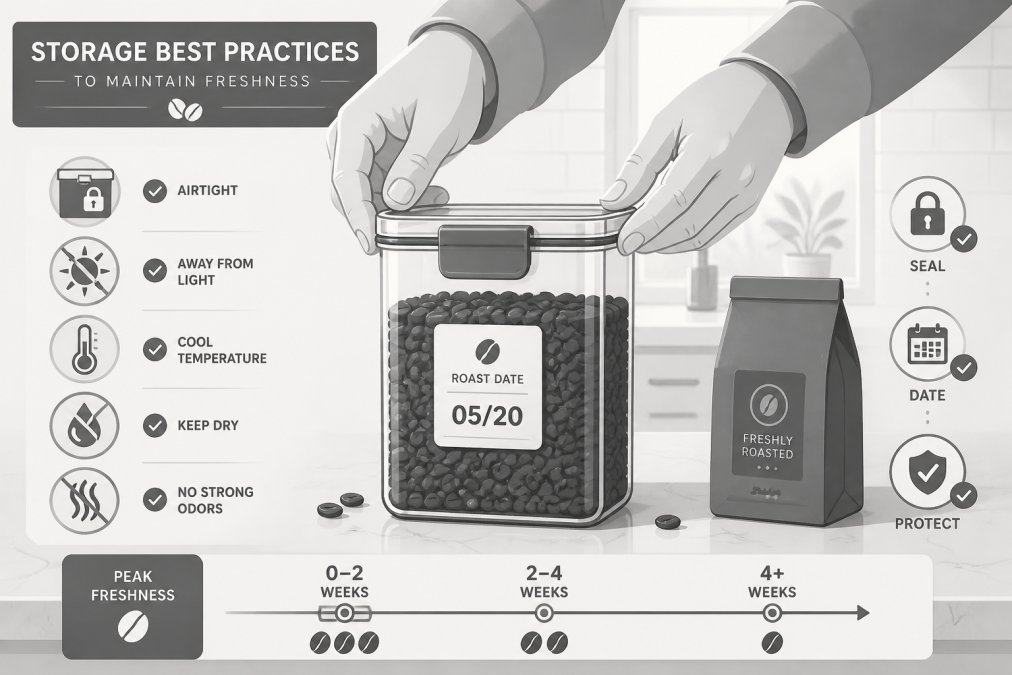
The best storage container is airtight, opaque, and kept in a cool location. Glass jars with airtight seals work well if stored away from light. Opaque, food-grade containers are ideal. Keep coffee in a cool cupboard, not on the counter or near a window. The ideal storage temperature is between 50 and 70 degrees Fahrenheit. Avoid the refrigerator or freezer, as temperature fluctuations cause moisture to condense inside the container.
Buy whole beans rather than ground coffee whenever possible. Whole beans maintain freshness far longer. Grind only what you need immediately before brewing. Store beans away from strong-smelling foods, as coffee is porous and will absorb odors.
| Storage Method | Freshness Window | Best For | Convenience |
|---|---|---|---|
| Airtight opaque container in cool cupboard | 4 weeks | Daily use | High |
| Vacuum-sealed bag in cupboard | 6-8 weeks | Bulk storage | Low |
| Original bag, sealed, in cool cupboard | 2-3 weeks | Short-term | High |
| Clear container on counter | 1-2 weeks | Poor choice | High |
| Refrigerator or freezer | 2-3 months | Emergency only | Medium |
The Last Sip Coffee Roasters ships freshly roasted coffee with a roast date clearly marked on the bag. When your beans arrive, transfer them to an airtight container and store in a cool cupboard to ensure you're tasting coffee at its peak.
The difference between freshly roasted coffee and stale beans comes down to the preservation of volatile oils and aromatic compounds. Freshly roasted coffee tastes better because those compounds are still present in full concentration.
At The Last Sip Coffee Roasters, we roast every batch to order so that the beans reaching your door are at the beginning of their optimal freshness window. Our 6 Bean Coffee Blend arrives roasted within days, ensuring you're brewing with beans at peak flavor. For those seeking something distinctive, our Bourbon Barrel Aged Coffee combines the complexity of barrel aging with the brightness of fresh roasting. Whether you prefer whole beans or the convenience of Original Roast Coffee Capsules, the principle remains the same: freshness transforms your morning cup from ordinary to exceptional.


Start with freshly roasted beans, store them properly in an airtight container, and grind immediately before brewing. These three steps alone will make a more noticeable difference in your coffee than any equipment upgrade.
Frequently Asked Questions
Why is freshly roasted coffee better than coffee that's been sitting for weeks?
Freshly roasted coffee contains higher concentrations of volatile aromatic compounds and carbon dioxide that create complexity and vibrant flavors. Within the first two weeks after roasting, these elements remain stable and contribute to a more nuanced sensory experience. After about three weeks, oxidation accelerates and aromatic compounds break down, resulting in flat, muted taste. The difference is most noticeable in the first 7-10 days when the coffee is in its optimal extraction window.
How long should you wait to drink freshly roasted coffee after the roast date?
Most specialty roasters recommend waiting 3-5 days after roasting before brewing. This allows the coffee degassing process to reach a point where carbon dioxide levels stabilize enough for proper extraction. However, the coffee remains excellent for up to 2-3 weeks. For espresso specifically, waiting 5-7 days produces the smoothest results. After 3 weeks, acidity increases and body diminishes noticeably, signaling the start of the staling process.
What are the signs of stale coffee beans you should watch for?
Stale coffee beans show several telltale signs: a dull, faded color instead of a glossy, rich brown; a lack of aroma when you open the bag; flat, one-dimensional flavor with increased sourness or bitterness; and reduced body or mouthfeel when brewed. If beans are older than 4 weeks from the roast date, they typically exhibit these characteristics. Whole beans deteriorate more slowly than ground coffee, but both show visible decline in flavor complexity and sweetness as oxidation progresses.
Does the coffee degassing process affect how fresh coffee tastes?
Yes, significantly. During degassing, roasted beans release carbon dioxide and volatile oils that contribute to flavor and aroma. In the first 24-48 hours, degassing is most intense and can actually make extraction difficult. By day 3-5, the process slows and the coffee reaches an optimal state where aromatic compounds are stable and extraction becomes clean and balanced. Understanding this timeline helps you brew at the peak of flavor development and explains why freshly roasted coffee from roasters like The Last Sip Coffee Roasters, roasted to order, delivers superior taste compared to beans sitting in warehouse inventory.
This article was written using GrandRanker