
Table of Contents
- Why Altitude Changes Everything About Your Pour Over
- The Boiling Point of Water at High Altitude and What It Does to Extraction
- Adjusting Grind Size for Elevation: Coarser Is Usually the Answer
- How to Reduce Coffee Bitterness: A Step-by-Step Troubleshooting Method
- Beans, Freshness, and Why Stale Coffee Tastes Bitter
- Equipment Calibration and Cleanliness for High-Altitude Brewing
- Conclusion
- Frequently Asked Questions
Last Updated: September 25, 2026
Why Altitude Changes Everything About Your Pour Over
If your pour over tastes harsh and ashy since you moved to a higher elevation, you are not imagining it. Altitude changes how water heats, how it moves through the coffee bed, and how fast flavor compounds leave the grounds. This guide from The Last Sip Coffee Roasters walks through the main causes of a bitter pour over at elevation and how to fix each one, so your cup never turns into a bitter pour over you dread.
The core problem is simple. Water boils at a lower temperature the higher you go. At sea level, water hits 212°F. Climb a few thousand feet, and that number drops. Lower brew temperature means your usual recipe no longer extracts the way it did before.
So the coffee you loved at sea level can turn bitter or sour at altitude. The beans did not change. The environment did.
Below, we cover the physics, then a step-by-step method to fix your cup.
The Boiling Point of Water at High Altitude and What It Does to Extraction
The boiling point of water at high altitude drops because there is less atmospheric pressure pushing down on the surface. Less pressure means water molecules escape as steam at a lower temperature. In the standard atmosphere, boiling point falls roughly 1.8°F for every 500 feet of gain near sea level, and the drop accelerates slightly as you climb because the air thins faster.
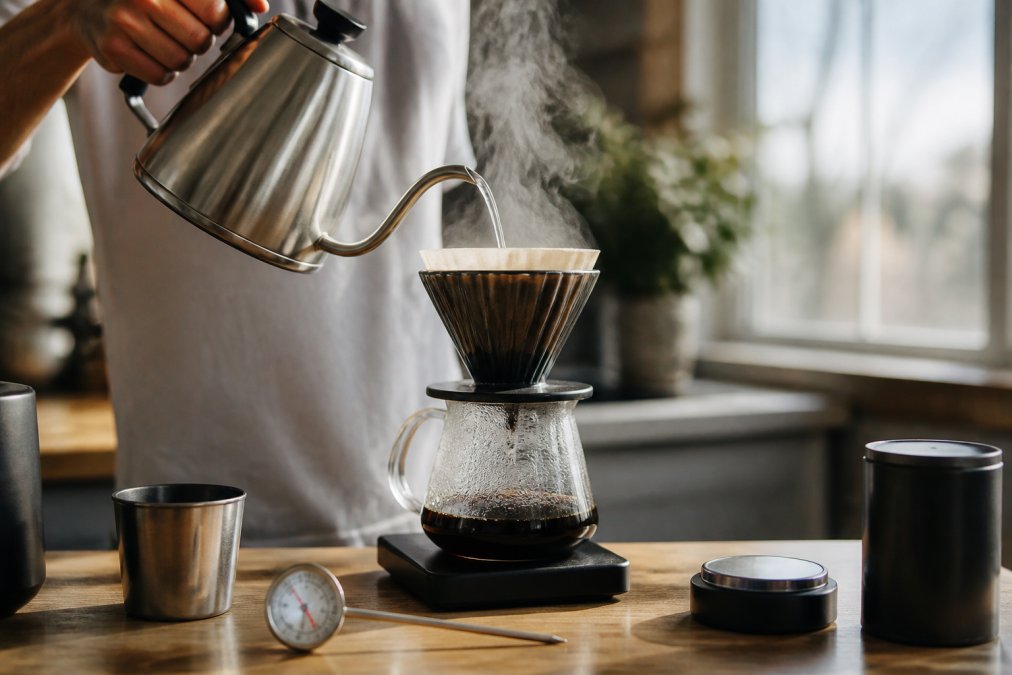
Here is what that looks like in practice, using the standard-atmosphere approximation:
| Elevation | Approx. boiling point |
|---|---|
| Sea level | 212°F |
| 3,000 ft | ~206°F |
| 5,000 ft | ~203°F |
| 7,000 ft | ~199°F |
| 10,000 ft | ~194°F |
Those numbers matter because the Specialty Coffee Association's brewing guidance puts the ideal slurry temperature at 195-205°F. At 5,000 feet, a rolling boil lands you at the bottom edge of that window. At 7,000 feet and above, boiling water is already below the target range, you physically cannot brew at the temperature your sea-level recipe assumed.
Here is the practical problem, and it is the part most guides get wrong. Your kettle may be at a rolling boil, but that water is cooler than what you used at sea level. A cooler slurry slows extraction. Under-extracted coffee usually tastes sour and thin, but at altitude the effect is messier: the top of the coffee bed extracts at a different rate than the bottom, so some compounds are pulled too far while others are left behind. The result is a cup that reads as harsh and bitter even though the underlying cause is under-extraction, not over-extraction. This is the single most common misdiagnosis at elevation.
So the first troubleshooting step is not 'grind coarser.' It is 'confirm what temperature you are actually brewing at.'
The fix is not to boil harder. You cannot raise the boiling point without a pressure vessel. A stovetop pressure cooker can push water above 212°F, but it is impractical for pour over and dangerous to open mid-brew. Instead, adjust the other variables:
- Use a thermometer to confirm your actual water temp at the slurry, not at the kettle spout
- Preheat your dripper and carafe with hot water so the ceramic or glass does not steal heat from the brew
- Keep the kettle on heat between pours to limit heat loss
- Insulate the dripper with a cloth or brew inside a warm room on cold mornings
- Accept a slightly finer grind to compensate for the cooler water, then re-tune from there
Adjusting Grind Size for Elevation: Coarser Is Usually the Answer
Adjusting grind size for elevation is the fastest lever you have. When water is cooler, it slows the flow and can pull too many bitter compounds from fine particles. Going coarser reduces contact time and evens out the extraction.
Start by backing off your grinder two to three clicks coarser than your sea-level setting. Then taste. If the cup still bites, go one more step.
Peruvian Coffee Brands | Peru →
Watch these signals:
- Bitter and dry: grind coarser
- Sour and thin: grind finer
- Both at once: your extraction is uneven, so check your pour technique
A coarser grind also helps your draw-down time.
How to Reduce Coffee Bitterness: A Step-by-Step Troubleshooting Method
Learning how to reduce coffee bitterness comes down to changing one variable at a time. Here is a method you can run in about ten minutes.
- Check your water temp. Aim for 195-205°F at the slurry. If it reads lower, preheat everything.
- Weigh your coffee and water. Use a scale. A brew ratio of 1:15 to 1:16 is a solid starting point.
- Adjust grind coarser. Move two clicks, then brew and taste.
- Shorten your contact time. Target a total brew between 2:30 and 3:30.
- Improve your pour. Pour in slow circles to avoid channeling through the coffee bed.
- Taste and repeat. Change one thing per brew until the cup balances.
| Problem | Likely Cause | Fix |
|---|---|---|
| Bitter, dry finish | Over-extraction | Coarser grind, shorter time |
| Sour, thin body | Under-extraction | Finer grind, hotter water |
| Stalls and chokes | Too fine, uneven bed | Coarser grind, gentler pour |
| Inconsistent cups | Poor agitation | Steady, even pouring |
Beans, Freshness, and Why Stale Coffee Tastes Bitter
Stale beans are a quiet cause of bitterness that most guides skip. As coffee ages, oils go rancid and oxygen flattens the sweet notes. What is left reads as harsh and bitter, no matter how good your technique is.
Equipment Calibration and Cleanliness for High-Altitude Brewing
Two gaps competitors miss are pressure and degassing differences and equipment calibration for altitude. Both matter more than most brewers realize, and both require actual numbers rather than vague advice.
Calibrate your gear to match your elevation band:
| Elevation | Grinder adjustment vs. sea-level baseline | Kettle target | Bloom rest |
|---|---|---|---|
| 3,000-5,000 ft | 1-2 clicks coarser | Local boil, ~203-206°F | 30-40 sec |
| 5,000-7,000 ft | 2-3 clicks coarser | Local boil, ~199-203°F | 40-45 sec |
| 7,000-10,000 ft | 3-4 clicks coarser, then re-tune | Local boil, ~194-199°F | 45-60 sec |
Now the equipment itself:
- Grinder: zero it, then reset your altitude baseline from scratch. Burr alignment matters more at altitude because a coarser setting exposes any wobble in the burrs, which produces fines that choke the bed and add bitterness.
- Kettle: verify temp with a thermometer, not the dial. Variable-temperature kettles often top out below the local boiling point, so the display can read 205°F while the water is actually cooler. Trust the probe, not the panel.
- Scale: confirm it reads grams accurately. A scale that drifts by 2-3 grams throws off your ratio more than most brewers realize, and at altitude you have less margin for error.
- Dripper: match the material to your climate. Ceramic holds heat well but steals it on the first pour if it is cold; plastic and glass lose heat faster. Preheat whichever you use.
Conclusion
Brewing at elevation is a constant negotiation with cooler water and faster degassing. The good news is that every fix is within your control: verify your temp, coarsen your grind, shorten contact time, and start with fresh beans.
Frequently Asked Questions
Why does my pour-over coffee have a bitter aftertaste at high altitude?
At higher elevations, water boils at a lower temperature, so your brew water is cooler than you expect. If you keep the same grind size and brew time, the water can still over-extract certain compounds while under-extracting others, leaving a harsh, bitter aftertaste. Try a slightly coarser grind and check your actual slurry temperature with a thermometer to confirm you're not below the sweet spot for your beans.
Should I adjust my water temperature for high altitude brewing?
Yes. Since water boils at a lower temperature up high, you need to adjust your target brew temperature downward or use a brewing method that maintains heat. Measure the slurry temperature with a thermometer rather than relying on the kettle setting. Aim for the lower end of the typical pour-over range and adjust based on taste. If your coffee still tastes bitter, increase the dose slightly or shorten the contact time.
Does high altitude require a coarser grind for pour over coffee?
Usually, yes. Because the boiling point of water at high altitude is lower, extraction happens differently. A coarser grind slows the release of bitter compounds and helps balance the cup. Start one or two clicks coarser on your grinder than your sea-level setting, then fine-tune based on draw-down time and flavor. If the cup tastes weak or sour, go slightly finer.
How do I know if my beans are stale and causing bitterness?
Stale beans lose their aromatic oils and can taste flat, cardboard-like, or harshly bitter. Check the roast date on the bag. For pour-over, beans roasted within the last two to three weeks tend to perform best. If your beans are older, try grinding coarser and using slightly cooler water to reduce the extraction of unpleasant compounds. Freshly roasted beans from a roaster like The Last Sip Coffee Roasters, which roasts to order, help you avoid this problem.