
Table of Contents
- Why Your Coffee Tastes Bitter (It's Not the Beans)
- How to Fix Over-Extracted Coffee: A Step-by-Step Troubleshooting Process
- Coffee Grind Size Chart: Match Your Grind to Your Brew Method
- The Ideal Water Temperature for Coffee Brewing (And Why 212°F Burns It)
- Coffee-to-Water Ratio and Brewing Time: The Two Numbers That Decide Everything
- Water Quality, Roast Level, and Freshness: The Variables Most People Ignore
- Equipment Troubleshooting: When the Machine Is the Problem
- Frequently Asked Questions
Last Updated: October 3, 2026
Why Your Coffee Tastes Bitter (It's Not the Beans)
If you're asking why is my coffee bitter, the answer is almost always over-extraction: hot water pulling too many bitter compounds out of the grounds.
At The Last Sip Coffee Roasters, we roast every batch to order, so we hear this question a lot.
Below are the steps to fix an over-extracted cup, plus the grind chart, water temperature, and ratio numbers that make it predictable.
Over-Extraction vs. Under-Extraction: Two Very Different Problems
Over-extraction is when water pulls too much out of the grounds, leaving a bitter, dry, harsh cup.
Under-extraction is the opposite. Water doesn't pull enough out, so the cup tastes sour, thin, and salty.
Most guides miss this: people taste a bad cup, assume it's bitter, and grind coarser, but sourness and bitterness get confused constantly. Name the flavor honestly before changing anything.
- Bitter, dry, lingering finish → over-extracted
- Sour, sharp, watery → under-extracted
- Both at once → uneven grind or poor agitation
How to Fix Over-Extracted Coffee: A Step-by-Step Troubleshooting Process
Learning how to fix over-extracted coffee comes down to changing one variable at a time and tasting after each change. Adjusting three things at once tells you nothing about which one worked.
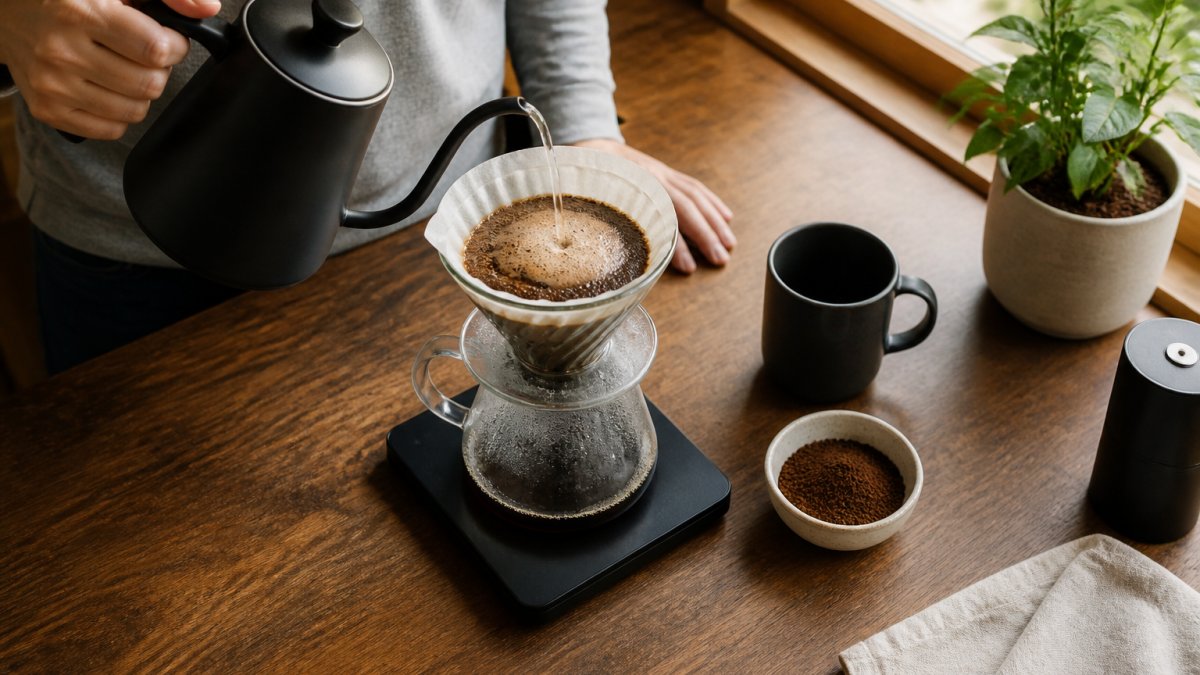
Step 1: Check Your Grind First
Grind size is the biggest lever you have. A fine grind exposes more surface area, so water extracts faster and pulls bitter compounds sooner.
If your cup is bitter, go one notch coarser, then brew again.
A common mistake is buying a burr grinder and never adjusting it. Blade grinders are worse: uneven particles mean some grounds over-extract while others stay under, so a cup tastes bitter and sour at once.
Step 2: Adjust One Variable at a Time
Change one thing, brew, taste, then decide.
- Grind coarser by one setting
- Drop water temperature by 5°F
- Shorten brewing time by 30 seconds
Keep notes. After three or four brews, you'll know which variable your setup is sensitive to.
Coffee Grind Size Chart: Match Your Grind to Your Brew Method
A coffee grind size chart removes the guesswork: match the grind to your brew method, then fine-tune.
| Brew Method | Grind Size | Brewing Time | Watch For |
|---|---|---|---|
| French press | Coarse | 4-5 min | Sediment, over-steeping |
| Cold brew | Very coarse | 12-18 hrs | Weak, watery result |
| Drip coffee | Medium | 4-6 min | Bitter, dry finish |
| Pour-over | Medium-fine | 2-4 min | Slow drain, channeling |
| Espresso machine | Fine | 25-30 sec | Harsh, ashy taste |
Start mid-range for your method. Bitter cup, move one step coarser; sour cup, one step finer.
Our Cold Brew Coffee is ground very coarse on purpose, which is why it steeps for hours without turning bitter.

The Ideal Water Temperature for Coffee Brewing (And Why 212°F Burns It)
The ideal water temperature for coffee brewing is 195°F to 205°F.
Most drip machines run too hot or too cool, and neither is obvious. A cheap thermometer fixes that in one brew.
Practical version: let a kettle sit 30 to 45 seconds after boiling, then pour.
With a French press, preheat first. A cold carafe drops water temperature by 10°F or more before extraction starts.
Coffee-to-Water Ratio and Brewing Time: The Two Numbers That Decide Everything
The standard coffee-to-water ratio is 1:15 to 1:18 by weight: 1 gram of coffee per 15 to 18 grams of water.
Too little coffee and the water over-extracts what's there, tasting bitter and thin; too much gives a concentrated, harsh cup.
Brewing time matters just as much: longer contact means more extraction, so a French press left eight minutes tastes bitter no matter how good the beans are.
Peruvian Coffee Brands | Peru Single-Origin Coffee →
- French press: 4-5 minutes
- Pour-over: 2-4 minutes
- Drip coffee: 4-6 minutes
Weigh your coffee. Scoops vary wildly, and a gram scale costs less than a bag of beans.
Water Quality, Roast Level, and Freshness: The Variables Most People Ignore
Water makes up roughly 98% of your cup, so quality changes everything. Most guides stop at "use filtered water," but the minerals in your water decide how aggressively it pulls bitter compounds from the grounds.
Water Chemistry: The Variable Almost Nobody Checks
Two numbers matter: hardness and alkalinity.
- Hardness is dissolved calcium and magnesium. Some is good: those minerals bind to coffee compounds and help flavor extract evenly. Water with almost no hardness (distilled, RO, or heavily softened) extracts flat and hollow, so people grind finer to compensate, which over-extracts and turns bitter.
- Alkalinity is the water's ability to neutralize acid. High-alkalinity water buffers coffee's bright acids, so the cup tastes flat and bitterness moves to the front. This is the most common cause of "my coffee is bitter no matter what I do" in homes with hard municipal water.
Most specialty roasters target roughly 50-150 ppm total hardness and 40-70 ppm alkalinity, with a pH near neutral. You don't need a lab: a $15 aquarium test strip or brewing-water test kit tells you which direction you're off.
If your tap water is high-alkalinity, three fixes, in order of effort:
- Carbon filter (pitcher or under-sink). Removes chlorine and some organics, but not hardness or alkalinity. Good for taste, not bitterness.
- Bottled or RO water blended with tap. Mix roughly 2 parts RO to 1 part tap to bring minerals back into range; straight RO is too soft and tastes flat.
- Third-wave water packets or brewing salts. Add a measured sachet to a gallon of distilled water. This is the most controllable option and what many competition brewers use.
Roast Level Changes the Extraction Window
Dark roasts sit in the roaster longer. Extended heat caramelizes sugars further and breaks down cell walls, making the bean more porous so water reaches soluble material faster. A dark roast extracts quickly and its bitterness window arrives sooner than a medium roast's.
A dark roast sweet at 3 minutes can taste ashy at 4. Medium roasts are more forgiving: denser structure, sugars less broken down.
Our Italian Roast Dark Roast Coffee has virtually no acidity and a heavy body, so it needs a coarser grind and slightly cooler water than a medium roast. Our Peru Single-Origin Coffee is a medium roast with low acidity and a salted caramel finish, far more forgiving if you're still dialing in technique.

Freshness: Stale Is Not the Same as Bitter
Coffee oxidizes once roasted. Surface oils go stale and the cup tastes flat and cardboard-like. People call that bitterness, but it's a different defect with a different fix.
A useful rule: beans are best roughly 4 to 21 days off roast for filter, 5 to 14 days for espresso.
Check the roast date, not the best-by date, which tells you nothing about when the coffee was roasted.
Bean Origin and Processing: The Baseline Bitterness You Can't Brew Out
Two beans roasted identically can taste different in bitterness because of how they were processed.
- Washed beans have the fruit stripped before drying. The cup is cleaner, brighter, more acidic, with lower, easier-to-control bitterness.
- Natural beans dry with the fruit on. Fruit sugars ferment into the bean, giving heavier body, more sweetness, and a fermented, sometimes boozy or earthy character. Naturals can read bitter or muddy if over-extracted, because there's more to pull out.
- Honey processing sits between the two, leaving some mucilage on the bean. Expect medium body and a sweetness that can tip bitter if your water is too hot.
If you've already fixed grind, temperature, and water, try a washed medium single origin. It removes the processing variable and gives you a cleaner baseline to dial in against.
Equipment Troubleshooting: When the Machine Is the Problem
Sometimes your technique is fine and the equipment is the issue. Use the matrix below to isolate the fault by brew method, then work the diagnostic order underneath.
Bitter-Cup Troubleshooting by Brew Method
| Brew Method | Most Likely Equipment Cause | Quick Check | Fix |
|---|---|---|---|
| Drip machine | Scale buildup lowering brew temp; shower head clogged | Measure finished brew temp with a thermometer in the carafe | Descale with a citric-acid or commercial descaler; scrub the shower head |
| Espresso machine | Brew pressure off; dirty shower screen or group gasket | Check pressure gauge against the machine's spec; pull a blank shot | Backflush with detergent; replace the gasket if it's cracked or stiff |
| French press | Rancid oils in the mesh filter; fine grounds passing through | Smell the filter after rinsing | Disassemble the plunger, scrub the mesh, and rinse with hot water |
| Pour-over | Channeling from a clogged paper or a warped dripper | Watch the bed drain; look for a crater or a dry patch | Rinse the filter, stir the bed, and level the dripper |
| Grinder | Stale grounds in the burrs; worn burrs producing fines | Brush out the burrs and brew a small test batch | Clean the burrs; replace them if the grind is inconsistent at the same setting |
The Diagnostic Order That Saves You Time
Work top to bottom. Each step rules out a class of causes before the next.
- Taste the water alone. If your tap water tastes off, no grind adjustment will fix the cup. Filter or blend first.
- Measure the finished brew temperature. A drip machine finishing at 180°F under-extracts, so you grind finer to compensate, which then over-extracts and turns bitter. A cheap instant-read thermometer in the carafe tells you in one brew.
- Check the flow rate. A drip machine finishing a full pot in under 4 minutes runs water through too fast, usually a grind problem, not a machine problem.
- Inspect the brew path. Shower screens, group gaskets, and mesh filters collect oils and residue that carry bitterness into the next cup.
- Clean the grinder. Stale grounds from last week's dark roast flavor this week's light roast. Brush the burrs every few weeks, not every few months.
Descaling: The Step Most People Skip
Scale is dissolved mineral that plates onto heating elements and thermostats. A scaled-up drip machine can run 10°F to 15°F cooler than its setpoint, pushing you toward under-extraction. You grind finer to compensate, and suddenly the cup is bitter.

Descale on a schedule tied to water hardness, not to when something tastes wrong:
- Soft water: every 3 to 6 months.
- Hard water: every 1 to 3 months.
- Very hard water: monthly, or switch to filtered water and stretch the interval.
Use a citric-acid or commercial descaler made for coffee equipment. Vinegar works in a pinch but leaves a residue that affects the next few brews.
Clean your gear on a schedule, not when something tastes wrong. A machine maintained within spec removes a whole category of variables from your troubleshooting.
Frequently Asked Questions
How do you take the bitterness out of coffee?
The fastest fix is to coarsen your grind. Bitter coffee almost always means over-extraction, which happens when water pulls too many bitter compounds from the grounds. Beyond grind size, lower your water temperature to between 195°F and 205°F, shorten your brewing time, and check that your ratio is close to 1:15 or 1:16 (coffee to water by weight). Change one variable at a time so you know what actually worked.
Does grind size affect coffee bitterness?
Yes, and it is the single biggest factor. A fine grind exposes more surface area, so water extracts faster and pulls bitter compounds along with the good ones. A coarse grind slows extraction down. If your coffee tastes bitter and dry, go one or two settings coarser on your grinder before you change anything else. If it suddenly tastes sour or weak, you went too far and should step back toward fine.
How does water temperature impact coffee flavor?
Water that is too hot strips bitter compounds and oils out of the grounds faster than it should. Water that is too cool under-extracts and leaves you with a sour, thin cup. The ideal water temperature for coffee brewing sits between 195°F and 205°F, which is just below boiling. If you do not have a temperature-controlled kettle, let boiled water rest for about 30 seconds before you pour.
What brand of coffee is the least bitter?
Bitterness is more about how you brew than which bag you buy, but roast level matters. Medium roasts and lighter tend to taste brighter with less of the heavy, roasted bitterness that dark roasts develop. A medium roast single-origin like a Peru lot, with its salted caramel and citrus notes and low acidity, brews a smoother cup than an extra dark Italian roast. If you love dark coffee, adjust your grind coarser to compensate.