
Table of Contents
- Tea Runners Alternative: What to Look for in a Specialty Tea Service
- Quick Comparison: The Last Sip Loose Leaf Teas
- Tea Subscription Box Reviews: Flavor Profiles That Stand Out
- How to Choose a Tea Subscription Box Based on Your Routine
- Best Loose Leaf Tea Subscription for Caffeine-Free Evenings
- Brewing Specialty Tea at Home: Steeping Times That Matter
- Why Sourcing and Freshness Beat Subscription Gimmicks
- Conclusion: Making the Switch to Specialty Loose Leaf
- Frequently Asked Questions
Last Updated: September 7, 2026
Tea Runners Alternative: What to Look for in a Specialty Tea Service
Subscription fatigue is real. When you start looking for a Tea Runners alternative for specialty tea, understand that not all "curated" boxes are created equal. At The Last Sip Coffee Roasters, we believe the measure of a great service isn't flashy packaging, it is what is inside the pouch.
A true specialty tea service should offer whole leaf quality you can see, harvest information you can verify, and blends that respect the ingredient. A common mistake is choosing a box based on price per shipment alone; that number hides the price per ounce and whether the leaf still carries its aromatic oils.
Here is what separates a worthwhile subscription from a tea-flavored loot box:
- Transparent sourcing. The service should name the origin of its base teas, not hide behind vague terms like "gourmet blend."
- Freshness protocols. Leaves should be packed in resealable, opaque pouches to protect them from light, air, and moisture.
- Brewing guidance. Quality tea is finicky. A good service tells you the correct water temperature and steeping time for each blend.
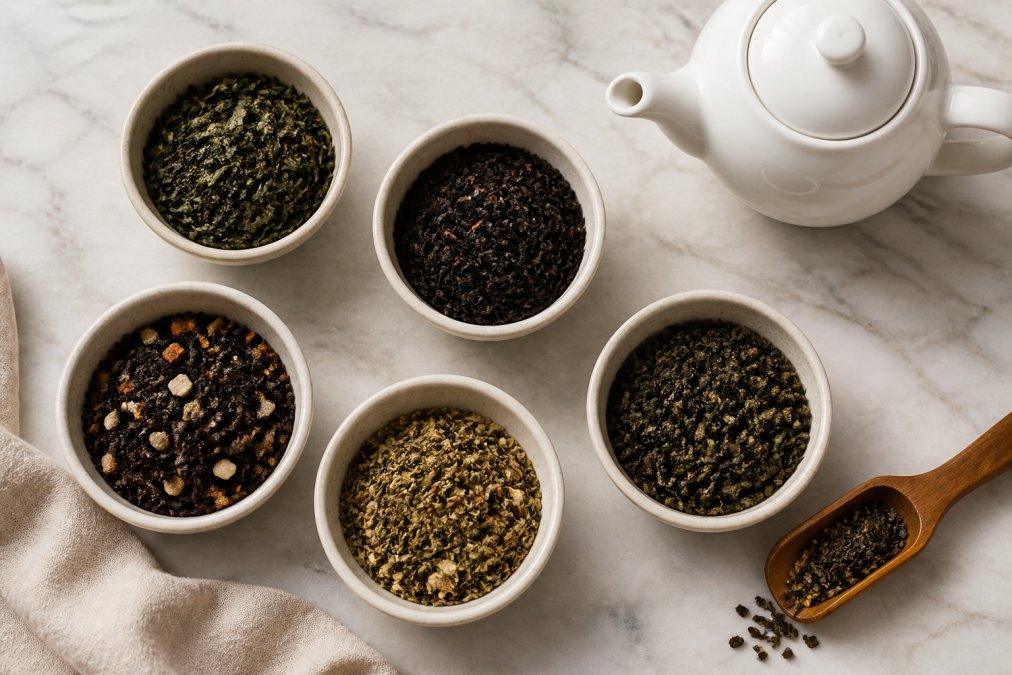
Quick Comparison: The Last Sip Loose Leaf Teas
Rather than locking you into a rigid monthly plan, The Last Sip Coffee Roasters offers one-time purchases of premium loose leaf tea. Each pouch costs $17.99 and is packed to order, meaning the leaf reaches you at peak condition. This suits drinkers who want variety without committing to a subscription cadence they might not finish.
| Tea | Base | Flavor Profile | Best Moment | Price |
|---|---|---|---|---|
| Jasmine Tea | Green tea | Sweet, floral, silky | Afternoon calm | $17.99 |
| Masala Chai Tea | Black tea | Bold, spicy, cardamom | Morning or midday | $17.99 |
| English Breakfast Tea | Black tea | Rustic, malty, sweet | Early morning ritual | $17.99 |
| Earl Grey Tea | Ceylon black tea | Citrus, floral, bergamot | Midday pick-me-up | $17.99 |
| Moroccan Mint Tea | Green tea | Vibrant, refreshing, minty | Hot or iced, any time | $17.99 |
A shorter, focused menu often signals higher quality. A roaster offering five well-executed teas is usually more careful with each leaf than a distributor juggling a hundred SKUs. The Last Sip Coffee Roasters offers a fine blend of freshly plucked jasmine blossoms and green tea, with the green tea picked by hand and prepared then set aside until the jasmine blossoms are ready. The two are paired at just the right time to create this harmony of fruity flavors on a medium-bodied green tea base.

Tea Subscription Box Reviews: Flavor Profiles That Stand Out
When you read tea subscription box reviews, pay close attention to whether the reviewer describes flavor notes or just packaging. The Masala Chai Tea from The Last Sip delivers a full-bodied, aromatic cup built on green cardamom, designed for traditional preparation with milk and sugar. You can taste the spice, rather than a generic "chai spice" dusting.

The Earl Grey Tea is built on a Ceylon OP base with visible blue cornflowers and a touch of bergamot essential oil. The tasting notes run toward orange, floral, and malt, with a high astringency that cuts through milk cleanly. This is a bold cup for drinkers who want the bergamot to lead.
A practical tip for evaluating any box: steep the tea plain first. Adding milk and sweetener masks flaws. A truly fresh, well-sourced leaf should taste sweet and rounded on its own. If a blend tastes flat or bitter without additions, the problem is usually stale leaf, not your brewing.
How to Choose a Tea Subscription Box Based on Your Routine
Your daily rhythm should dictate your tea choices. Start by mapping your consumption patterns across a typical week. How many cups do you actually drink? Do you prefer a bold, caffeinated start or a gentler ramp into the day?
For a traditional morning cup that stands up to milk, the English Breakfast Tea is the obvious choice. It is a blend of African and Indian tea, intentionally rustic and sweet, designed to carry milk without losing its character. If your mornings run long, the Masala Chai delivers an invigorating jolt with its warming spice profile.

The Moroccan Mint Tea is the versatile workhorse. It refreshes beautifully hot or iced, transitioning from a mid-morning cup to an afternoon cooler. It also holds up to multiple steepings, stretching your price per ounce considerably, a hidden value most subscription boxes do not advertise.
Best Loose Leaf Tea Subscription for Caffeine-Free Evenings
Drinkers searching for the best loose leaf tea subscription for caffeine-free evenings often get tripped up by labeling. A "calming" blend that contains green tea will still deliver caffeine. True caffeine-free options come from rooibos, honeybush, chamomile, or peppermint, plants that contain no tea leaf at all.
The challenge with The Last Sip's current tea menu is that all five core blends are built on either green or black tea bases, which means they are caffeinated. For a genuinely caffeine-free evening cup, you would look to the herbal category, which is not the focus of this particular lineup. That is an honest limitation worth naming.
For those who do want a lower-caffeine wind-down that still offers ritual, the Jasmine Tea is the gentlest option in the lineup. Because it is a green tea, it has less caffeine than the black blends, and its sweet, smooth, silky character is calming in a way that a brisk breakfast tea is not. Steep it for a shorter time in cooler water to further soften the caffeine extraction.
Brewing Specialty Tea at Home: Steeping Times That Matter
The difference between a good cup and a great cup of loose leaf tea comes down to water temperature and steeping time. Most people overheat the water and over-steep the leaf, producing a bitter cup. A true specialty tea service should arm you with the precise parameters that unlock each leaf's full potential, because the chemistry of extraction is not one-size-fits-all.
Tea leaves contain catechins and tannins. At water temperatures above 200°F, these compounds extract rapidly, overwhelming the delicate amino acids (like L-theanine) that provide sweetness and umami (peer-reviewed research). Over-steeping does the same thing, even at lower temperatures. Understanding this extraction curve is the difference between a service that treats tea as a commodity and one that treats it as a craft.
Temperature and Time by Tea Type
Different tea types demand different extraction profiles. Here are the parameters that matter, based on the leaf structure and oxidation level:
- Green Tea (e.g., Jasmine Tea): Water at 170°F to 180°F. Steep for 2 to 3 minutes. Green leaves are minimally oxidized and delicate. Boiling water denatures the chlorophyll and scorches the leaf, releasing vegetal, bitter compounds. The jasmine blossoms in The Last Sip's Jasmine Tea are layered with the leaf during processing; a gentler steep allows those floral notes to unfurl without turning astringent.
- Black Tea (e.g., English Breakfast, Earl Grey): Water at 200°F to 212°F. Steep for 3 to 5 minutes. Fully oxidized leaves are robust and can handle near-boiling water. The Ceylon base in the Earl Grey is a broken-leaf OP grade, which exposes more surface area. That means extraction is faster; a 5-minute steep at 200°F yields a bold, malt-forward cup, while pushing to 7 minutes risks pulling out excessive tannins that make the tea taste dry and grippy.
- Spiced Blends (e.g., Masala Chai): Water at 212°F. Steep for 5 minutes, or simmer for 10 minutes if you are preparing it the traditional way with milk. The spices in the Masala Chai, green cardamom, require higher heat to release their volatile oils. A quick steep in cooler water leaves the spices muted and the tea thin. For a proper chai, the leaf and spice need a rolling boil to create a full-bodied, aromatic brew.
- Mint Blends (e.g., Moroccan Mint): Water at 185°F. Steep for 2 to 3 minutes. The green tea base is the limiting factor here; the mint leaves are forgiving, but the base will turn bitter if you push past 3 minutes at higher temperatures. The mint in this blend is a top-note addition, so a shorter steep preserves its cool, refreshing character.
The Re-Steep Curve: Getting More from Your Leaf
The Jasmine Tea and the Moroccan Mint Tea are both good for multiple steepings. After the first pour, add slightly hotter water and extend the steep by 30 seconds. The second and third cups are often smoother and sweeter, effectively lowering your cost per serving.
The first steep pulls out the most volatile aromatic compounds. The second steep, with hotter water and a longer time, extracts deeper, sweeter compounds like theanine and simple sugars. This is why high-quality whole leaf tea can deliver three or four satisfying infusions, while a commodity-grade tea bag exhausts itself in one steep because the leaf is already shattered.
A Practical Brewing Protocol for Evaluation
When you are evaluating a new tea service, use a standardized brewing protocol to compare apples to apples. Here is a simple method that most specialty tea professionals use:
- Measure by weight, not volume. Use 2.5 grams of leaf per 8-ounce cup. Volume measurements are unreliable because different leaf shapes pack differently.
- Use filtered water. Chlorine and mineral imbalances in tap water can mask or distort flavor compounds.
- Steep plain first. Adding milk and sweetener masks flaws. A truly fresh, well-sourced leaf should taste sweet and rounded on its own. If a blend tastes flat or bitter without additions, the problem is usually stale leaf, not your brewing.
- Time it. Do not guess. Use a timer. A 30-second over-steep on a delicate green tea is the difference between a silky cup and a bitter one.
The Last Sip Coffee Roasters includes brewing guidance with every pouch, but the deeper principle is this: a specialty tea service earns its name not just by sourcing good leaf, but by giving you the tools to brew it correctly. If a service cannot tell you the ideal temperature for its own blend, that is a red flag that the leaf is not the priority.
Why Sourcing and Freshness Beat Subscription Gimmicks
Tea leaves do not go visibly stale the way bread does, but they lose their volatile aromatic oils over time. A tea that was vibrant at harvest becomes flat after months on a retail shelf. This is why freshness protocols matter more than the size of the monthly box.
A roaster that packs to order is protecting the flavor you paid for. The Last Sip Coffee Roasters applies the same made-to-order philosophy to its tea that it does to its coffee. Leaves are packed when you order, not when the warehouse got around to it.
Sustainability and ethical sourcing are important. A smaller menu built on direct relationships with growers can give you a clearer picture of where your leaf came from. That transparency is worth paying for.
Conclusion: Making the Switch to Specialty Loose Leaf
Switching from a rigid subscription box to a made-to-order loose leaf tea service requires a small shift in mindset. You trade the convenience of an automatic monthly shipment for the control of choosing exactly what lands in your pantry. For most specialty drinkers, that trade is worth making.
But there is a deeper question: how do you know a tea service will hold your interest past the first three months? The novelty of a new box fades, and the reality of working through a backlog of tea you did not choose sets in.
The Three-Month Fatigue Factor
A common pattern among some subscription tea services is that the rotation can start to repeat, or the curation shifts toward filling volume rather than delighting the palate. The result can be a pantry full of tea you are not excited to brew.
Here is the honest consumer-centric framework for evaluating any tea service's long-term value:
- Does the service let you choose, or does it choose for you? A rigid monthly box assumes your taste is static. In reality, your preferences shift with the season, your stress levels, and your schedule. A service that locks you into a fixed rotation will eventually miss the mark. A made-to-order model, where you select each pouch, keeps your pantry aligned with your actual cravings.
- What is the cost per cup, not per box? A $20 box with 4 ounces of tea sounds reasonable until you calculate that you are paying $5 per ounce for leaf that you might not finish (consumer.ftc.gov). The Last Sip's $17.99 pouches contain 4 ounces of whole leaf tea. At roughly 2.5 grams per cup, that is about 45 cups per pouch, or roughly $0.40 per cup. That is the number that matters for your monthly budget, not the sticker price of the shipment.
- Does the service support re-steeping? High-quality whole leaf tea is designed for multiple infusions. If a tea can be steeped three times, the effective cost per serving drops to about $0.13. That is a value proposition that commodity tea bags cannot match, and it is a direct hedge against the feeling that you are wasting money on a subscription you are not fully using.
- Can you pause or skip without penalty? The best services understand that life happens. A flexible model that lets you order when you need tea, rather than on a fixed calendar date, eliminates the guilt cycle of paying for tea you are not drinking.
The Last Sip Difference: Control as an Antidote to Fatigue
The Last Sip Coffee Roasters brings the same care to its tea selection that it applies to its coffee, with every batch roasted to order and every pouch packed for maximum freshness. There is no auto-ship trap, no minimum commitment, and no pressure to finish a box before the next one arrives.
This model is not for everyone. If you enjoy the surprise of a curated monthly box and drink enough tea to keep up, a subscription might serve you well. But for the drinker who wants specialty quality without the waste, the made-to-order approach is the more sustainable choice, both for your palate and for the environment.
The measure of a great tea service is not how many boxes it ships. It is how many cups you actually look forward to brewing. Explore the loose leaf tea collection at The Last Sip Coffee Roasters and find a blend that rewards a proper steep, and a second steep, and a third.
Frequently Asked Questions
What makes a good Tea Runners alternative for specialty tea?
A strong alternative should offer freshly packed loose leaf tea, clear tasting notes, and honest steeping instructions. Price per ounce matters, but freshness and sourcing quality matter more. The best options let you buy single pouches without forcing a long-term commitment, so you can test the flavor profile before subscribing.
Which loose leaf tea is best for a caffeine-free option?
For an evening cup, skip the green and black teas and look for rooibos, honeybush, chamomile, or peppermint. These herbal blends contain no caffeine and steep well at lower temperatures. A rooibos base offers a naturally sweet, full-bodied cup that stands up to milk if you prefer it. Always check the pouch label, since some mint blends include green tea and will keep you awake.
How much loose leaf tea should I use per cup?
Use about one level teaspoon of loose leaf tea for an 8-ounce cup. For a stronger brew, add more leaf rather than steeping longer, which can bring out bitterness. Dense blends like masala chai or English breakfast can handle a bit more volume. Weighing your tea gives the most consistent results, but a standard teaspoon works well for everyday brewing.
Can I buy specialty tea without a subscription commitment?
Yes. Many specialty tea services, including The Last Sip Coffee Roasters, sell individual pouches as a one-time purchase. This lets you sample flavors like jasmine or Earl Grey before signing up for monthly delivery. A one-time purchase is also a practical way to compare quality across different roasters, so you can decide which subscription fits your routine without pressure.