
Table of Contents
- Why Loose Leaf Tea Beats Bagged Tea for Flavor
- What You'll Need to Brew Loose Leaf Tea
- Best Water Temperature for Brewing Green Tea (and Every Other Type)
- How to Measure Loose Leaf Tea Per Cup
- Loose Leaf Tea Steeping Times Chart
- Step-by-Step: How to Brew Loose Leaf Tea for Maximum Flavor
- Water Quality and TDS: The Variable Most People Ignore
- Common Mistakes That Ruin Loose Leaf Tea
- Frequently Asked Questions
Last Updated: September 16, 2026
Why Loose Leaf Tea Beats Bagged Tea for Flavor
Loose leaf tea is whole or large-cut tea that steeps freely in water, allowing leaves to expand and release their full range of oils and aromatics. Bagged tea typically contains fannings, the fine dust left over from processing, which has far more surface area exposed to air before you ever open the box.
That matters because flavor compounds in tea are volatile. The smaller the piece, the faster it oxidizes and the flatter it tastes. Whole leaves protect their own aromatics until hot water does the work of opening them up.
At The Last Sip Coffee Roasters, we source teas built for this kind of brewing, including blends designed for multiple steepings. Once you taste the difference, going back to a paper bag is genuinely hard.
Here's what most guides skip: the leaf isn't just bigger. It's structurally intact, so it releases flavor in layers over time instead of dumping everything at once. That's why a good loose leaf tea tastes different at 90 seconds than it does at three minutes.
Below, we'll walk through everything you need, from water temperature to measuring, so you can brew a cup that actually tastes like the tea you paid for.
What You'll Need to Brew Loose Leaf Tea
You need four things: loose leaf tea, a brewing vessel, a way to heat water, and something to measure with. That's it. No specialty gadget is required to start.
Your core kit:
- Loose leaf tea, ideally fresh and stored away from light and heat
- An infuser, strainer, or brewing vessel
- A kettle, ideally one with temperature control
- A kitchen scale or measuring spoon
- A timer, which your phone handles fine
A common mistake is buying an expensive tea and steeping it in a mug with a tea ball that's too small. The leaves need room. Cramped leaves can't circulate, so you get a thin, uneven cup no matter how good the tea is.
Choosing Your Infuser or Brewing Vessel
The best vessel is the one that gives leaves room to expand and lets you remove them cleanly when the steep is done. Everything else is preference.
Basket infusers fit most mugs and give leaves decent space. They're the easiest starting point and work well for most black and herbal blends.
Mesh strainers sit over a cup or pitcher. You brew loose in a separate vessel, then pour through the strainer to decant. This gives the leaves maximum room and is my preferred method for full leaf teas.
French presses are excellent for tea, even though most people only associate them with coffee. The plunger traps leaves at the bottom, and the glass lets you watch the color develop. Just press gently and decant promptly so the tea doesn't keep extracting.
Gaiwans are the traditional Chinese vessel: a small lidded bowl you pour from directly. They're ideal for oolong and green tea because you control each infusion precisely and can re-steep many times.
Tea balls and small clamp infusers are the weakest option. They work in a pinch, but the leaves stay compressed and steep unevenly. If you already own one, use it for finely cut teas rather than full leaf.
Best Water Temperature for Brewing Green Tea (and Every Other Type)
The best water temperature for brewing green tea is 160-180°F. Green tea leaves are delicate and less oxidized, so water that's too hot pulls out tannins aggressively and turns the cup bitter and astringent.
Temperature is the single biggest variable most people ignore, and it's the one that most reliably ruins a good tea. Boiling water is fine for black tea and herbal infusions. It is not fine for green or white tea.
Here's the practical range by type:
- White tea: 160-175°F, the gentlest treatment
- Green tea: 160-180°F
- Oolong: 185-205°F, depending on how oxidized the leaf is
- Black tea: 200-212°F, right off the boil
- Herbal infusion: 212°F, since there's no true tea leaf to damage
Our Moroccan Mint Tea, for example, brews best at 185°F for 2-3 minutes, which sits right in the oolong-to-green overlap because it pairs green tea with fresh mint. Our Earl Grey Tea calls for 195°F for 5-10 minutes, since Ceylon black tea can take the heat.


Temperature Troubleshooting: What to Do Without a Thermometer
No thermometer? You can still hit the right range with a few reliable tricks.
Bring water to a full boil, then let it rest.
How to Measure Loose Leaf Tea Per Cup
The standard starting point is one level teaspoon of loose leaf tea per 8 ounces of water. That's roughly 2-3 grams for most teas, though it varies by leaf size and density.
Quick reference:
- Fine or broken leaf: about 2 grams per teaspoon
- Full leaf black or oolong: about 2.5 grams per teaspoon
- Large, fluffy white or green leaf: about 1.5 grams per teaspoon, so use a heaping spoon
Loose Leaf Tea Steeping Times Chart
Steeping time is where flavor balance is won or lost. The chart below covers the standard ranges for each tea type. Treat these as starting points, not rules.
| Tea Type | Water Temperature | Steeping Time | Notes |
|---|---|---|---|
| White tea | 160-175°F | 2-3 minutes | Delicate, lightly sweet |
| Green tea | 160-180°F | 2-3 minutes | Turns bitter fast if over-steeped |
| Oolong | 185-205°F | 3-5 minutes | Tolerates re-steeping well |
| Black tea | 200-212°F | 3-5 minutes | Stands up to milk and sugar |
| Herbal infusion | 212°F | 5-7 minutes | No true tea leaf, so no bitterness risk |
Re-Steeping: Getting a Second and Third Cup From the Same Leaves
Re-steeping is the practice of brewing the same leaves more than once, and it's one of the clearest advantages loose leaf tea has over bags. Whole leaves hold flavor in layers, so each infusion tastes slightly different.
Step-by-Step: How to Brew Loose Leaf Tea for Maximum Flavor
Here's the full process, start to finish. Total time is about 8 minutes, most of which is waiting for water to cool.
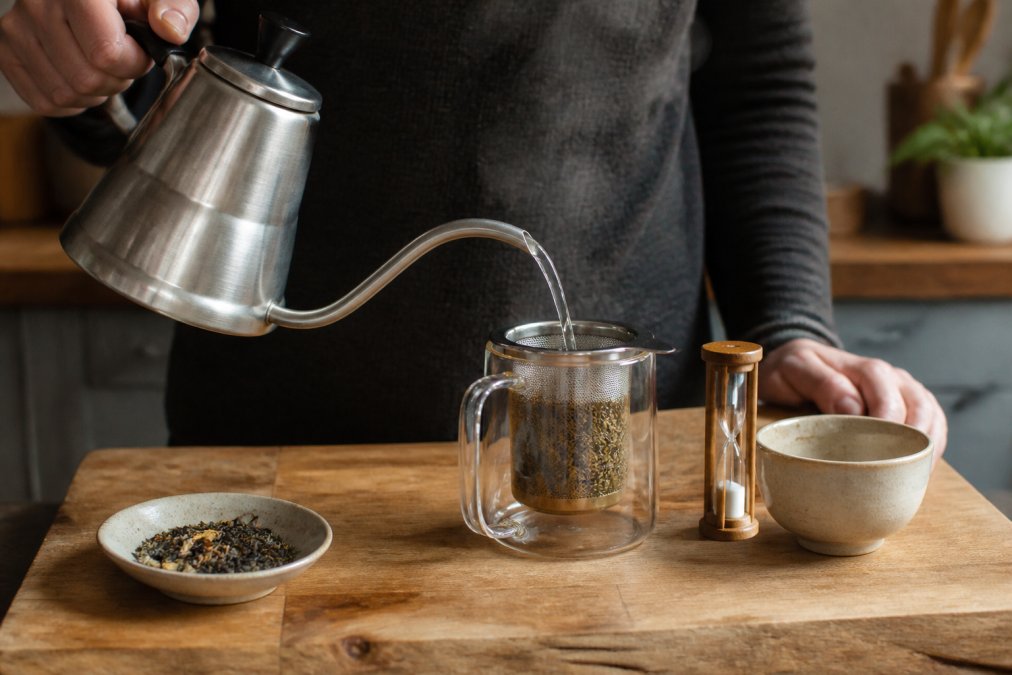
- Heat your water to the right temperature for your tea type. Green and white teas need cooler water; black and herbal need it near boiling. [Time: 3-5 minutes]
- Measure your leaf. One level teaspoon per 8 ounces of water, or weigh it if you want consistency. [Time: 1 minute]
- Add the tea to your infuser or vessel. Give the leaves room. Don't pack them tight.
- Pour the water over the leaves. Pour steadily so all the leaf gets saturated, not just the top layer.
- Watch the leaves hydrate. You'll see them unfurl and expand within the first 30 seconds. This is the bloom, and it's a good sign the leaf is fresh.
- Start your timer. Use the chart above for your tea type. [Time: 2-5 minutes]
- Remove or decant the tea. Don't leave leaves sitting in the water unless you want a bitter cup. If you're re-steeping, set them aside rather than tossing them.
- Taste before you commit. If the cup tastes thin, add more leaf next time. If it's harsh, drop your temperature.
Water Quality and TDS: The Variable Most People Ignore
Water is roughly 99% of your cup, so its chemistry matters more than most brewers admit. TDS, or total dissolved solids, measures the minerals left in your water after filtration.
Common Mistakes That Ruin Loose Leaf Tea
Most bad cups trace back to a handful of fixable errors. Fix these and your tea improves immediately.
Frequently Asked Questions
What is the golden ratio for loose leaf tea?
The standard starting point is 1 level teaspoon of loose leaf tea per 8 ounces of water, roughly 2 to 3 grams. For a stronger cup, use 1 heaped teaspoon or 3 grams. Whole-leaf teas like jasmine or oolong often need slightly more volume because the leaves are larger and less dense. Fluffy white teas can require up to 2 teaspoons per cup. Weighing your leaves on a small kitchen scale gives the most consistent results, especially when you're dialing in a new tea.
Does water temperature affect the flavor of loose leaf tea?
Water temperature is the single biggest lever you control. Green tea brewed at 175°F releases sweetness and aroma; pour 212°F water over the same leaves and you pull out bitter tannins within seconds. Black tea and herbal infusions need water closer to boiling to extract full body and depth. The best water temperature for brewing green tea sits between 160°F and 180°F, while oolong lands around 185°F to 195°F. Getting this right transforms the same leaves from harsh to smooth.
Why does my loose leaf tea taste bitter?
Bitterness almost always comes from one of three things: water that is too hot, steeping too long, or too many leaves for the amount of water. Tannins extract faster at higher temperatures, so a green tea steeped at a rolling boil turns astringent in under a minute. Try dropping your water temperature by 10 to 15 degrees, cutting your steeping time by 30 seconds, and tasting as you go. Unlike bagged tea, loose leaf gives you full control over every variable, so small adjustments make a noticeable difference.
How long should you steep different types of loose leaf tea?
Steeping times vary by tea type. White tea: 4 to 5 minutes at 175°F. Green tea: 2 to 3 minutes at 175°F. Oolong: 3 to 4 minutes at 185°F to 195°F. Black tea: 3 to 5 minutes at 195°F to 212°F. Herbal infusions: 5 to 7 minutes at 212°F. Use a loose leaf tea steeping times chart as your baseline, then adjust to taste. Most loose leaf teas reward a second or third steeping, often with slightly longer times each round.